What if retained dividend cash earns a return?
Result under receipt-before-interest ordering
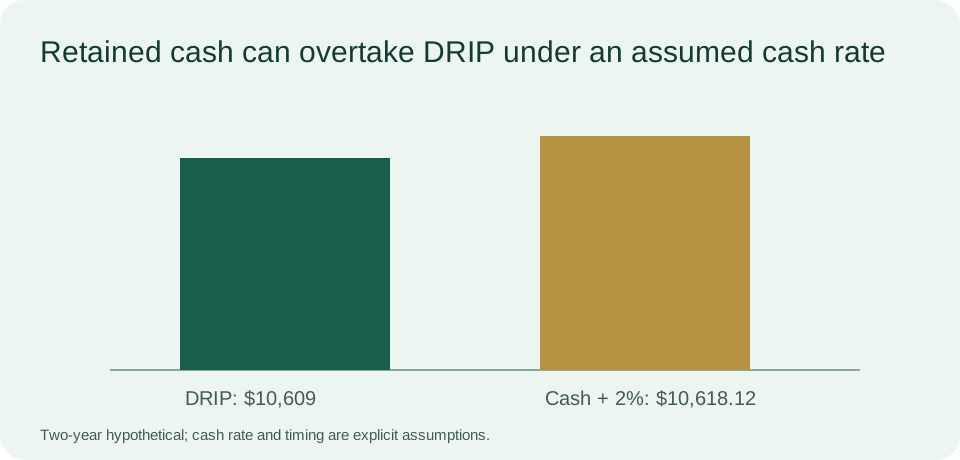
Using $10,000, a stated 3% annual dividend input and zero growth or additions, DRIP ends at $10,609.00 after two modeled years. If dividends are retained as cash and that cash earns an explicitly hypothetical 2% annual rate after each year's receipt, the cash path ends at $10,618.12. In this fixture, cash is higher by $9.12.
The 2% is a scenario input, not a current bank rate, SCHD yield or promise. The result depends on applying interest after each dividend receipt. Change the timing or rate and the answer changes.
Timing boundary: This equation credits a receipt before a full interest step. It does not model a receipt arriving at the end of that same interval. Two $300 year-end receipts at an assumed 2% cash rate total $606, not $618.12. See the cash-interest timeline audit.
Keep the two balances separate
The DRIP path adds each modeled dividend to the investment balance. The retained-cash path leaves the investment at $10,000, adds $300 of assumed dividend cash each year, then applies the assumed 2% cash return to the accumulated cash. No market price, tax, fee, broker rule or actual payout date is used.
Year 1 cash: ($0 + $300) × 1.02 = $306. Year 2 cash: ($306 + $300) × 1.02 = $618.12. The retained-cash total is $10,000 + $618.12 = $10,618.12. DRIP is $10,000 × 1.03 × 1.03 = $10,609.00.
Download every row
Each row keeps the dividend, cash interest, retained cash, DRIP assets and comparable total. Recompute the cash column as (prior cash + current dividend) × (1 + cash rate).
| Year | Dividend | Cash interest | Retained cash | DRIP assets | Cash path total |
|---|---|---|---|---|---|
| 1 | $300.000000 | $6.000000 | $306.000000 | $10,300.000000 | $10,306.000000 |
| 2 | $300.000000 | $12.120000 | $618.120000 | $10,609.000000 | $10,618.120000 |
Boundary tests keep the rate honest
At a 0% cash rate, retained cash ends at $10,600 and DRIP at $10,609, so the cash path is $9 lower. At a 0% dividend input, both paths remain at $10,000. At zero starting assets, both paths remain zero. A negative cash rate is rejected rather than silently treated as a new financial assumption.
| Case | Cash path total | DRIP assets | Difference | Status |
|---|---|---|---|---|
| base | 10618.120000000000 | 10609.000000000000 | 9.120000000000 | valid |
| zero_cash_rate | 10600.000000000000 | 10609.000000000000 | -9.000000000000 | valid |
| zero_yield | 10000.000000000000 | 10000.000000000000 | 0.000000000000 | valid |
| zero_principal | 0.000000000000 | 0.000000000000 | 0.000000000000 | valid |
| negative_cash_rate | — | — | — | invalid_rejected |

Sources and method
The production calculator source is linked at growth-calculator.js. The general compounding concept can be checked against Investor.gov's compound interest calculator. SCHD fund context is linked to Schwab Asset Management. None of those pages supplies the 2% scenario input; it is labeled as an assumption throughout.
Formula: DRIP total = P × (1 + y)2. Retained cash total = P + (((P × y) × (1 + c) + P × y) × (1 + c)), where P is starting assets, y is the stated annual dividend input and c is the hypothetical cash rate.
Questions this model can answer
Does a positive cash rate always beat DRIP?
No. It depends on the principal, dividend input, number of steps, cash-rate timing and all other assumptions. This page tests one two-year fixture.
Is 2% a current SCHD or deposit yield?
No. It is an explicit hypothetical input chosen to make the sensitivity visible.
Can I use actual payouts here?
Only after replacing the modeled dividend rows with dated, source-backed observations and keeping eligibility and timing explicit. This page intentionally avoids claiming that its annual steps are SCHD payment dates.