SCHD calculator year limits: 0, blank, and 51
What the current code returns
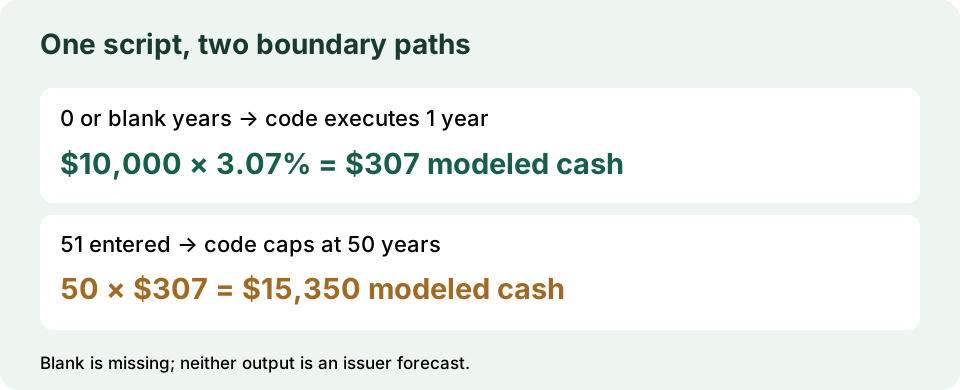
0, a negative number, or blank runs one model year; 51 runs 50. This is software behavior, not a SCHD forecast. Under a hypothetical $10,000 balance, 3.07% assumed yield, zero additions or growth and DRIP off, the one-year display is $307; the 50-year cumulative display is $15,350. Blank is still missing user information even though code falls back to one.
Use the SCHD dividend calculator with an intentional holding period. The form advertises a range of 1 to 50 years; this page tests the JavaScript boundary beneath that control, not your broker account or an issuer promise.
Replay the actual year clamp
The published calculator script parses the year input, substitutes 1 when parsing produces a falsy number, then applies a lower bound of 1 and an upper bound of 50. That sequence matters: 0 becomes 1 at the fallback, -2 becomes 1 at the lower guard, and 51 becomes 50 at the upper guard. A blank string also reaches 1 in the software, but it does not tell us that the reader deliberately chose one year.
| Case | Entered years | Rows produced | Exact modeled cumulative dollars | Home display | Interpretation |
|---|---|---|---|---|---|
| zero year | 0 | 1 | $307.0000 | $307 | outside form range; code falls back to 1 |
| negative year | -2 | 1 | $307.0000 | $307 | outside form range; lower guard runs 1 |
| blank year | blank | 1 | $307.0000 | $307 | missing/unknown choice; code falls back to 1 |
| one year | 1 | 1 | $307.0000 | $307 | valid one-year choice |
| fifty years | 50 | 50 | $15350.0000 | $15,350 | valid upper boundary |
| fifty one years | 51 | 50 | $15350.0000 | $15,350 | outside form range; code caps at 50 |
| zero capital | 50 | 50 | $0.0000 | $0 | valid zero-money boundary |
Download every input and expected result (CSV) · Download the input/source map (CSV).
Why the two display amounts differ
For the controlled test, the $10,000 balance stays constant because additions and share-price growth are set to zero and DRIP is off. The first-year modeled dividend is $10,000 × (3.07 ÷ 100) = $307.0000. Fifty repeated model years at the same assumed yield produce 50 × $307.0000 = $15,350.0000 of cumulative modeled dividends. This is a calculation rule under fixed inputs; it does not say SCHD will maintain a dividend for fifty years.
The 0, negative, blank, and 1-year code replays each produce one row and display $307. The 50 and 51-year replays each produce fifty rows and display $15,350. A zero-capital case produces fifty rows but $0. These equal outputs arise from different inputs, so the downloadable matrix retains the original entry and a separate interpretation instead of calling every row a valid selection.
Blank is not a verified one-year choice
The home page has a number field with a visible 1-to-50-year range. The code-level replay does not prove that a browser will accept every out-of-range typed value, or that a blank means the reader chose one year. In the CSV, script rows produced records the current code; semantic status marks blank as unknown and negative or out-of-range input as invalid for the published form. Do not substitute the displayed fallback for a confirmed investment horizon.
The form's future-income result depends on separate yield, growth, contribution and DRIP assumptions. This page isolates the year-control behavior so those other inputs cannot hide the boundary. For dated fund distributions, consult Schwab's SCHD source; no future distribution amount is filled in here.
Questions about the holding period
Does entering 51 mean a 51-year SCHD forecast?
No. The current JavaScript caps the loop at 50 rows. Fifty years of repeated test input is not a guaranteed return or payment schedule.
Why does entering zero still show one year?
The numeric fallback turns a parsed zero into one before the loop. The form's stated valid range starts at one, so zero should be corrected as an input rather than interpreted as a requested year.
Is an empty years field the same as choosing one year?
No. It produces one row in this code replay, but it is missing user information. The test CSV marks its interpretation unknown.
Does a $0 result mean SCHD made no distribution?
No. The test matrix's zero-capital case has no assumed money invested. An issuer's actual historical distributions are a different source and unit.
Sources and audit boundary
The production calculator JavaScript is the source of the fallback and clamp. The current home form supplies the 1-to-50 field range and the dated editable 3.07% scenario preset. A public SCHD calculator discussion illustrates why long-horizon input labels matter; no forum number is used as a fund fact. The fixed DRIPCalc, Snowball and Wisesheets pages were read as a bounded structural sample. This page's exact code trace, independent arithmetic and boundary classifications are its own work, not a claim about the entire web or Google ranking.
