Which SCHD calculator inputs are facts, and which are assumptions?
Historical worksheet: this page reconstructs the September calculator snapshot. The live homepage model was corrected on October 4, 2026 to remove a duplicate half-year contribution term. Its current output therefore differs from the older replay below when contributions are nonzero. Use the corrected live model or download current regression examples.
Start with the first-year answer
The DividendSteps home calculator's current presets model $505.17 of first-year dividends; $10,000 × 3.07% alone would be $307.00. The difference is not a newly announced SCHD payment. The home formula also includes its editable $500 monthly contribution and 7% price-growth assumption when it estimates the year's average invested value. The exact unrounded outputs are $505.1685 and $307.0000, respectively. This page replays that code, one changed field at a time.
The six numbers in the home form and its DRIP switch are model controls, not seven fresh issuer observations. The 3.07% yield preset is labeled on the home page as a September 10, 2026 snapshot; 10.6% is a historical editorial growth estimate reused for a future scenario; 7.0% price growth is explicitly an estimate. Schwab's fund page currently displays a different dated distribution-yield measure, 3.00% as of August 31, 2026. Those two dates and methods should stay attached to their values; neither is a guarantee for a future payment.
This is an audit of our own published model, not advice on a suitable yield or growth rate. Source amounts, modeled outputs and individual account records answer different questions. No 2026 Q4 distribution or future market price is filled in here.
A source label for every home control
The table reads the current live-matched home form and its growth-calculator.js. A preset can be useful for a reproducible example without becoming an issuer forecast. An official distribution row is shown separately so it cannot be mistaken for a form field.
| Field | Displayed value | Origin | What it does and does not mean |
|---|---|---|---|
| Initial Investment | 10000 USD | user scenario | Not an issuer balance; change to your actual amount. |
| Monthly Contribution | 500 USD/month | user scenario | Assumed to arrive evenly within each model year. |
| Holding Period | 20 years | user scenario | Sets loop length, not a guaranteed holding period. |
| Current Dividend Yield | 3.07 percent | dated site preset | A static editable snapshot; not fetched from Schwab at run time. |
| Annual Dividend Growth | 10.6 percent/year | historical editorial estimate reused as scenario | Past CAGR is not an issuer forecast. |
| Annual Share Price Growth | 7.0 percent/year | site-set scenario estimate | Not an official expected return. |
| DRIP | on boolean | user scenario choice | Affects modeled reinvestment after year-one accrual. |
| SCHD Sep 2026 distribution | 0.2665 USD/share | issuer observation, not a home form input | Historical issuer record; not fed into the home growth script. |
Download the field-source map as CSV. The Schwab observation is the September 23 ex-date, September 28 payable date and $0.2665-per-share distribution listed on its fund page; it is not fetched by the home projection script.
Why the first-year number is not $307
The current script sets annual contribution C = 12 × monthly contribution, computes a value before dividends P = I × (1 + g) + C × (1 + g/2), then uses average value A = (I + P)/2 + C/2. Here I is the entered initial investment and g is the entered annual share-price-growth fraction. Its first-year modeled dividend is yield fraction × A. This is the site's stated annual-step convention, including a half-year treatment for contributions, not an observation of when anyone bought actual SCHD shares.
At today's home presets: C = 12 × $500 = $6,000; P = $10,000 × 1.07 + $6,000 × 1.035 = $16,910; A = ($10,000 + $16,910)/2 + $3,000 = $16,455; 0.0307 × $16,455 = $505.1685 before cent display rounding. The issuer did not announce $505.1685; it is a software output under these inputs.
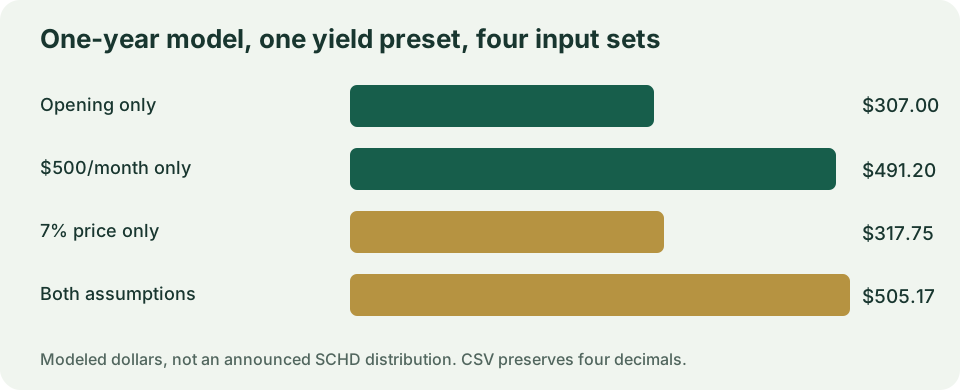
Opening only
$10,000 initial; $0 monthly; 0% price growth → $307.00
Contribution only
$10,000 initial; $500 monthly; 0% price growth → $491.20
Price only
$10,000 initial; $0 monthly; 7% price growth → $317.75
Both presets
$10,000 initial; $500 monthly; 7% price growth → $505.17
Changing contribution alone adds $184.2000 to the exact opening-only case; changing price growth alone adds $10.7450. The two changes together add $198.1685, which is $3.2235 more than the sum of those isolated changes. That extra term is not market alpha: it is the model's contribution × price-growth interaction, C × g × yield / 4. It shows why reading the yield preset by itself cannot explain the result.
What changes later, not in year one
The script's effective yield in model year y is entered yield × (1 + entered dividend growth)y−1. At y = 1, the exponent is zero: replacing the 10.6% growth preset with 0% leaves the first-year dividend unchanged in this code. The 20-year holding preset only determines how many annual rows to run; it does not multiply the first year's observed issuer payment by twenty. Both statements are about code behavior, not evidence that SCHD's actual dividend or share price will grow at those rates.
The DRIP switch also leaves this first-year dividend amount unchanged because the code adds modeled reinvested cash to the portfolio after computing that year's dividend. It can change later-year modeled balances. A reader comparing the two long-run paths should first check whether DRIP, contributions and growth assumptions are the same, then read the table by year. This is a controlled test of one algorithm; it does not reconcile broker execution prices or fractional shares, which belong in the separate DRIP statement worksheet.
Replay the first-year bridge with your own assumptions
This small audit form uses the same first-year formula and rejects an empty field. It does not fetch a price, dividend declaration, tax rate or account statement. For the full multi-year model, return to the main SCHD dividend calculator.
Default model: $505.1685 before cent rounding; $505.17 displayed. The 3.07% input is a dated site preset, not a live issuer promise.
Zero is an input result; blank is unknown
Set the entered yield explicitly to 0% and the model's year-one dividend is $0.0000 even with money invested; this does not mean Schwab announced zero per share. Keep yield at 3.07% but set both initial investment and monthly contribution to $0, and the modeled result is also zero for a different reason. Two different input conditions can therefore produce the same display. The CSV names them separately so a reader can reproduce the cause rather than treating a zero output as a fact about the fund.
A blank yield is missing information, not a verified zero. The current home script uses a fallback that converts an empty numeric field to 0 before calculating; this audit form instead reports unknown: enter a yield assumption and leaves the missing-yield test row's numeric output empty. A negative initial amount is rejected here. These are input-validation boundaries in our worksheet, not changes to the historical distribution table or predictions of a future cut.
| Case | Initial | Monthly | Yield % | Price growth % | Year-one output |
|---|---|---|---|---|---|
| opening only | 10000 | 0 | 3.07 | 0 | $307.00 |
| contribution only | 10000 | 500 | 3.07 | 0 | $491.20 |
| price only | 10000 | 0 | 3.07 | 7 | $317.75 |
| both defaults | 10000 | 500 | 3.07 | 7 | $505.17 |
| explicit zero yield | 10000 | 500 | 0 | 7 | $0.00 |
| explicit zero capital | 0 | 0 | 3.07 | 7 | $0.00 |
| missing yield | 10000 | 500 | blank | 7 | unknown |
Download all input and expected-output cases as CSV. Numeric cells stay blank for missing or invalid inputs; $0.0000 is reserved for an explicit valid zero case.
Questions to ask before trusting a projection
Is the 3.07% preset today's official SCHD yield?
No. Our home page labels it as a September 10, 2026 snapshot compiled from named sources. Schwab's own page currently displays distribution yield (TTM) 3.00% as of August 31, 2026; that has a different reference date. Neither number is a future distribution commitment. Check the issuer's date and metric definition before replacing a model input.
Is 10.6% dividend growth a Schwab forecast?
No. The home page presents it as an editorial historical CAGR preset, then the simulator extends it forward as an adjustable assumption. A past rate is not a declared next payment. Year one in this code does not use the growth rate because its exponent is zero.
Does turning DRIP off change the first-year dividend here?
No. Under equal first-year inputs, this algorithm computes the year's gross modeled dividend before adding reinvested cash to the later portfolio balance. DRIP can affect subsequent rows. Your broker's real transaction uses an execution price and share-credit rules absent from this first-year source audit.
What should I check if my result looks too high?
First label every field as a dated observation or a scenario choice. Then hold all but one field fixed and rerun. The four-case bridge above shows the amount added by contributions, price growth and their interaction under one site preset. It is a software sensitivity test, not a recommendation to use any particular rate.
Sources and scope
Schwab SCHD fund and distributions supplies the dated September 2026 distribution row and the issuer's dated TTM yield. DividendSteps home and its published calculator script supply the audited input defaults and formula. A public reader question about long-horizon SCHD calculator reliability prompted this audit, not any numeric assumption. The fixed DRIPCalc, Snowball and Wisesheets pages were read for structural comparison only; this page's independent arithmetic concerns our own code. Nothing here is an investment recommendation or a whole-web originality claim.