SCHD DRIP Calculator: Reconcile Cash and Shares
How a SCHD DRIP calculator turns cash into new shares
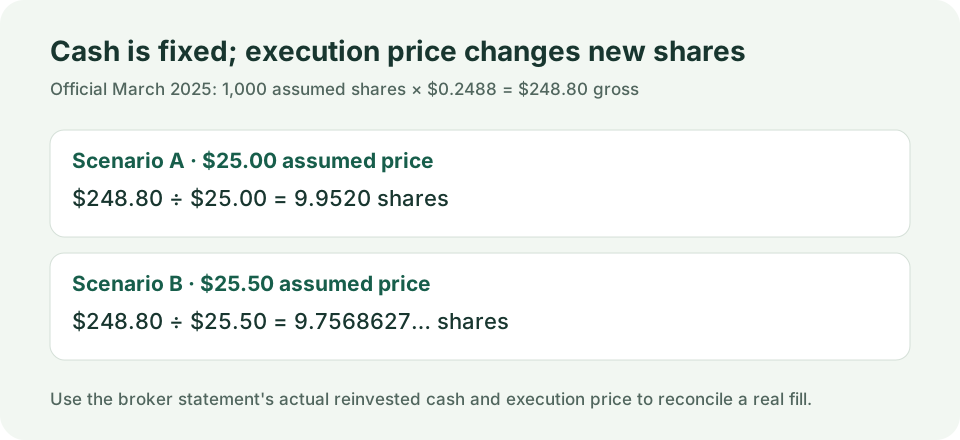
A distribution per share determines gross cash; an execution price determines how many new shares that cash can buy. Schwab lists $0.2488 per SCHD share for the March 2025 distribution. With an explicitly assumed 1,000 eligible shares, gross cash is 1,000 × $0.2488 = $248.80. If all $248.80 were reinvested at a hypothetical $25.00 purchase price, the unrounded quotient would be 9.952 shares; at a hypothetical $25.50 it would be 9.756862745… shares. Those are different modeled results from the same issuer payout, not actual brokerage fills.
To reconcile your own account, use the cash actually reinvested, the broker's actual purchase price, and the shares credited on its statement. A calculator that silently uses a payable-date quote, an assumed price or a different rounding rule cannot establish what your broker did. Missing execution data is unknown, not zero or proof of an error.
Separate issuer record from account record
Schwab Asset Management's SCHD distribution history records a March 26, 2025 ex-date, March 31 payable date and $0.2488 total distribution per share; the next June 25 ex-date and June 30 payable date show $0.2602. Those issuer rows were checked against Schwab's published page on September 29, 2026. They say nothing about a particular investor's share balance, DRIP election or execution price.
The Schwab One Account Agreement describes crediting reinvested shares by dividing eligible cash by a purchase price. It says that price can be a weighted average when several purchases are needed, that purchase timing is at Schwab's discretion, and that partial shares are calculated to four decimal places. Those terms describe that program, not every broker or every account. The agreement does not turn a displayed ETF quote on the payable date into your actual fill price.
| Issuer ex-date | Payable date | SCHD total distribution per share | Role here |
|---|---|---|---|
| Mar 26, 2025 | Mar 31, 2025 | $0.2488 | Fixed first payout input |
| Jun 25, 2025 | Jun 30, 2025 | $0.2602 | Illustrative next-payout sensitivity |
Download these two dated issuer rows as CSV. The numbers below add assumed account inputs to these rows; no price in this page is represented as a 2025 market observation.
Two prices, one cash amount
Hold issuer cash at $248.80. Scenario A divides it by an assumed $25.00 and gets 9.9520 new shares before account-level rounding. Scenario B divides the same cash by an assumed $25.50 and gets 9.756862745… before rounding. The unrounded difference is 0.1951372549… share. Both prices are deliberately hypothetical sensitivity inputs; neither is Schwab's or another broker's recorded purchase.
At four decimal places, Scenario A still reads 9.9520. Scenario B would read 9.7569 if rounded to nearest four decimals or 9.7568 if truncated. The agreement establishes a four-decimal share precision, but the page does not use it to assert which rounding convention appeared in any account. Obtain credited shares from the statement.
Suppose, only to show the downstream effect, that each unrounded share result is added to the initial 1,000 shares before the issuer's June $0.2602 per-share row. Scenario A's next gross is (1,000 + 9.952) × $0.2602 = $262.7895104, displayed as $262.79. Scenario B's is (1,000 + 9.756862745…) × $0.2602 = about $262.7387, displayed as $262.74. The five-cent displayed difference is a model sensitivity; actual entitlement, credited shares, price and withholding can differ.
Reconcile a SCHD DRIP calculator result with one statement line
Enter assumed eligible shares for the March issuer record, the cash your account actually reinvested, an observed or explicitly assumed execution price, and optionally the shares the broker credited. The tool keeps issuer gross and account cash separate. It displays an unrounded cash÷price quotient and a four-decimal illustrative nearest-rounding view. It never claims that view is the broker's exact share-rounding rule.
Default: issuer gross $248.80; $248.80 ÷ assumed $25.00 = 9.9520 modeled new shares before rounding.
If the account's reinvested cash differs from the issuer-gross example, compare the statement's eligible share count, DRIP election and any withholding or other cash adjustment. This tool does not inspect your private account. Do not enter account identifiers, credentials or personal records here.
SCHD DRIP calculator zero and missing-price tests
The CSV test matrix contains both hypothetical prices and four boundary cases. It records the original issuer row, explicit account assumptions, unrounded quotient and two illustrative four-decimal outcomes. A valid zero cash amount buys zero modeled shares; a positive cash amount with missing execution price is unknown, not zero. A zero or negative execution price is invalid, as is negative cash.
| Case | Cash to reinvest | Assumed price | Modeled shares / state |
|---|---|---|---|
| Price A | $248.80 | $25.00 | 9.9520 before rounding |
| Price B | $248.80 | $25.50 | 9.756862745… before rounding |
| Zero shares and cash | $0.00 | Not needed | 0, valid zero |
| Missing price | $248.80 | Unknown | Unknown, not 0 |
| Zero price | $248.80 | $0.00 | Reject input |
| Negative cash | −$1.00 | $25.00 | Reject input |
Check these SCHD DRIP calculator assumptions before comparing
Why might two brokers credit different SCHD shares for the same issuer payout?
The issuer amount can match while the amount reinvested, execution timing, purchase price or credited-share precision differs. A public reader question about different fills motivated this audit; that report alone cannot establish a broker mistake. Compare each account's actual transaction record.
Can I use SCHD's payable-date closing price as my DRIP execution price?
Only as an explicitly labeled model assumption. The Schwab One agreement describes actual purchase-price and timing rules; your statement's transaction price is the relevant input for your own reconciliation.
If DRIP is off, did the dividend disappear?
No. The issuer can still pay a gross distribution while the account keeps it as cash rather than buying additional shares. A zero-share purchase is not proof of a zero distribution. See the separate zero-result boundary tests.
Do four decimals guarantee my modeled shares will match?
No. Four-decimal display alone does not settle execution price, reinvested-cash amount or the broker's exact rounding treatment. The CSV shows more than one four-decimal convention precisely to avoid pretending the account rule was observed.
Is the example a forecast of future SCHD DRIP returns?
No. The issuer payouts are historical, the execution prices and initial holding are assumptions, and future dividends and market prices are unknown. This page is a one-transaction arithmetic audit, not an investment recommendation.
Watch the SCHD DRIP calculator cash-to-shares audit
Watch the DividendSteps narrated explanation on YouTube. It follows the same issuer row and clearly assumed purchase prices. The downloadable source and boundary cases above remain the reproducible record. The narration is synthetic; this does not depict a real account or broker fill.
SCHD DRIP calculator cash adjustments
The historical examples above do not assert an account charge. To isolate a separately declared deduction, use the hypothetical fee sensitivity worksheet. Its zero-fee branch preserves the distinction between a documented zero and missing information.

For an explicit multi-purchase example, the weighted fill-price worksheet reconciles total cash and shares without substituting an unweighted price average. Its execution inputs are hypothetical.