SCHD yield input: 3.07 or 0.0307?
What to enter
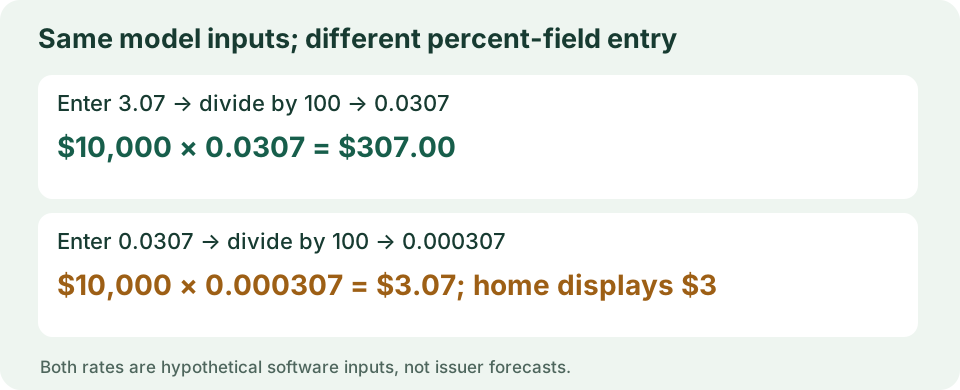
Enter 3.07 in the (%) field for a 3.07% assumption. On $10,000, that models $307.00; entering 0.0307 models $3.07. This is a controlled one-year software scenario, not SCHD's current yield or next payment. The DividendSteps home calculator divides the number typed in its Assumed annual yield (%) field by 100. Entering 0.0307 there models 0.0307%, one hundredth of 3.07%; all other replay inputs are held fixed.
This tests our current software, not SCHD's next payment or today's issuer yield. The home's 3.07 preset is editable and dated; it is not fetched live from Schwab. Your actual future dividend amount remains unknown.
Follow the unit through the calculation
The field label ends in (%), but the script needs a fraction for multiplication. Its first step is entered number ÷ 100. For 3.07, the fraction is 0.0307; for 0.0307, the fraction is 0.000307. The controlled first-year test keeps initial amount at $10,000, monthly additions at $0, years at 1, modeled dividend and share-price growth at 0%, and DRIP off. Under these inputs the current code's average-balance formula reduces to the $10,000 starting balance, so only the yield unit changes.
$10,000 × 0.0307 = $307.00
$10,000 × 0.000307 = $3.07
Exact arithmetic versus the homepage display
We executed the currently deployed calculator JavaScript unchanged in a small DOM-stub replay, then calculated the exact first-year amounts independently with decimal arithmetic. The replay is a code execution, not a browser click. Its summary formatter rounds to whole dollars, which is why the $3.07 exact case appears as $3 on the home result card. A very small, still nonzero modeled $0.01 appears as $0. A rounded display cannot tell you whether the underlying exact result was zero.
| Case | Entered (%) | Internal fraction | Exact model | Home display |
|---|---|---|---|---|
| percent entry | 3.07 | 0.0307 | $307.0000 | $307 |
| decimal entered as percent | 0.0307 | 0.000307 | $3.0700 | $3 |
| explicit zero | 0 | 0 | $0.0000 | $0 |
| blank yield | blank | unknown | unknown | $0 |
| nonzero hidden by whole dollar display | 0.0001 | 0.000001 | $0.0100 | $0 |
| zero capital | 3.07 | 0.0307 | $0.0000 | $0 |
Download all percent-entry and boundary tests (CSV). Every row lists the fixed inputs, internal fraction, exact modeled amount, home-script display and interpretation. Download source and rule map (CSV).
Zero, blank and rounded-to-zero are different
Typing an explicit 0% with $10,000 correctly models $0.00. Typing 3.07% with $0 initial capital and no additions also models $0.00, for a different reason. Typing 0.0001% with $10,000 models $0.0100, yet the home result says $0 because it rounds to a whole dollar. These are three distinct test inputs. The CSV keeps all three rather than merging them into a single zero label.
Leaving the home yield field blank currently also displays $0: the script's numeric fallback converts an empty string to zero. A blank entry is missing information, not a verified 0% yield. This audit records the exact amount for that case as unknown even though the unmodified home code displays $0. The main home UI can be improved later to distinguish those states; this page does not invent a fund fact from a form fallback.
Do not confuse a model rate with issuer cash records
Schwab's SCHD distributions list completed 2026 income of $0.2569, $0.2525 and $0.2665 per share for March, June and September payable dates. Their observed sum is $0.7759 per share; an illustrative holding of 100 eligible shares at each event would have $77.59 gross cash. That is three completed events, not a full-year yield, and it does not validate either 3.07% or 0.0307% as a current forward rate. December's dollar payment is unknown here.
The software example begins with hypothetical dollars invested, whereas the issuer ledger begins with actual per-share cash. To compare them for a real account, you would need dated eligible share counts and your own purchases or reinvestments. Substituting an invented share price to bridge $10,000 into shares would create a false precision, so this page keeps the two evidence types separate.
Quick answers before you rerun the calculator
Do I type 3.07% or 0.0307 into this form?
Type the number 3.07 when the field label already says (%). The code divides it by 100 once. Entering 0.0307 in that field instructs this software to use 0.0307%, not 3.07%.
Why does the home result show $3 rather than $3.07?
The current summary formatter rounds to whole dollars. The controlled one-year test produces $3.0700 before display rounding; the downloadable CSV preserves those decimals.
Does a $0 display mean SCHD paid nothing?
No. It can mean explicit zero, zero capital, a blank field that fell back to zero, or a positive amount below the display's rounding threshold. Inspect the inputs and issuer payment record before drawing a conclusion.
Is the 3.07% home preset today's official SCHD yield?
No. It is a dated, editable site scenario preset. Use our dated yield reference or the issuer page for a yield with a documented measurement date; do not treat this software trace as a current quote.
Sources and scope
The current DividendSteps form and its published calculator script are the primary evidence for the unit conversion and display behavior; the downloadable tests preserve independently recalculated exact outputs. Schwab's dated distribution table is used only for the separate completed-payment example. A public question about differing calculator outputs prompted this input audit, not any of its numbers. The three locked comparison sites were read for structure, but no competitor sentence or unsupported claim of a sitewide gap was imported. Results are educational model diagnostics, not investment advice or a prediction.